
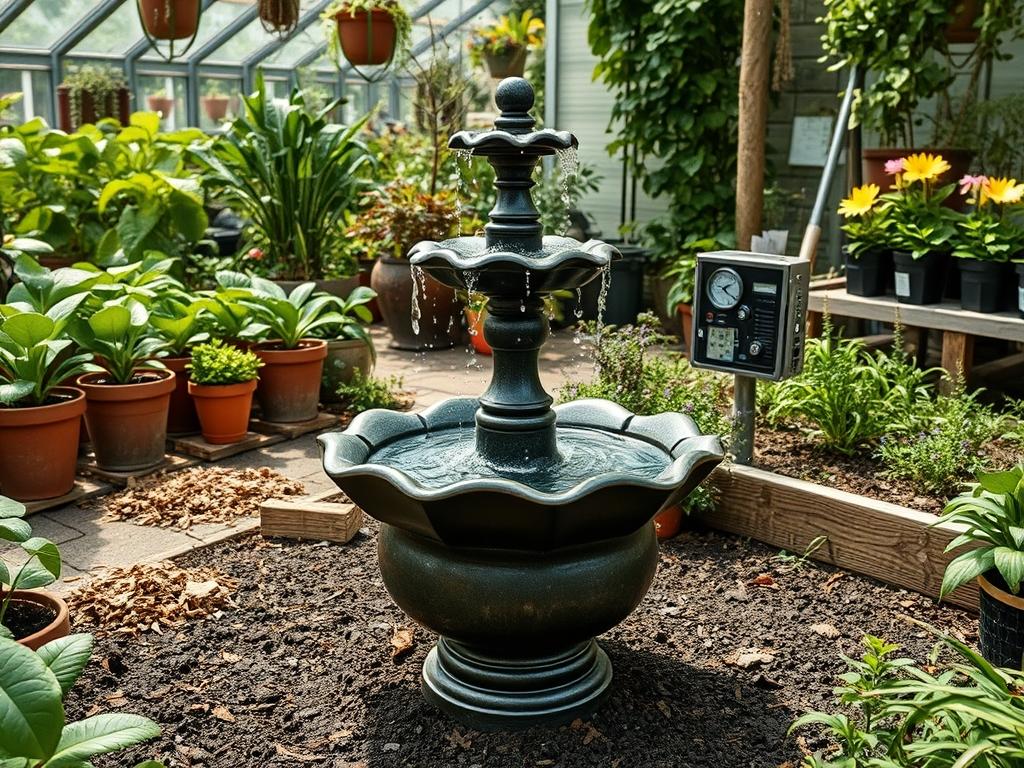
Modern landscape architecture faces a persistent challenge: balancing aesthetic grandeur with sustainable infrastructure. Traditional water features often demand complex electrical installations, necessitating invasive trenching across established lawns or expensive rewiring of exterior panels. Solar powered fountains offer a sophisticated solution to this dilemma, providing the auditory tranquility of flowing water without the carbon footprint or utility costs associated with conventional pumps. By utilizing photovoltaic technology, these features can be positioned in remote garden corners or atop isolated retaining walls where wired power is inaccessible. This flexibility allows for a more dynamic use of space, enhancing curb appeal while adhering to eco-friendly design principles. The transition toward solar technology represents a shift in how we perceive outdoor functionality; it is a movement away from high-maintenance systems toward self-sustaining ecosystems that thrive on natural inputs.
Integrating a solar powered fountain requires a deep understanding of site orientation and solar harvest potential. As a landscape architect, I prioritize the placement of the monocrystalline solar panel to ensure it receives at least six to eight hours of direct sunlight. This is not merely a technical requirement but a design constraint that dictates the flow of the garden. A well-placed fountain serves as a biological cooling agent, lowering the ambient temperature of a patio or seating area through evaporative cooling. Furthermore, the inclusion of moving water attracts local pollinators and birds, transforming a static backyard into a vibrant, living habitat. When selecting a unit, one must consider the material durability, looking for glass-fiber reinforced concrete or high-impact resin that can withstand UV exposure and temperature fluctuations without degrading.
Landscape Design Principles
Successful garden design relies on a structured hierarchy of visual elements. When incorporating solar powered fountains, the principle of the focal point is paramount. A fountain should act as the terminus of a visual axis, drawing the eye through the garden and providing a sense of destination. In formal gardens, symmetry is often used to create a sense of order. Placing a circular fountain at the intersection of two flagstone walkways creates a classical “cross-axis” design that feels grounded and intentional.
Elevation layers are equally critical across the vertical plane. A fountain should not sit in isolation on a flat lawn; instead, it should be integrated into a tiered planting scheme. We use the “rule of three” to establish these layers. The fountain serves as the middle layer, supported by a grounding layer of creeping thyme or river stones at its base, and framed by a backdrop of taller architectural plants like ornamental grasses or columnar evergreens. This creates a sense of enclosure and makes the water feature feel like an organic part of the topography. Visual balance is achieved by counterweighting the fountain’s mass with complementary hardscaping, such as a stone bench or a retaining wall, ensuring the space does not feel lopsided or cluttered.
Plant and Material Selection
The following table outlines plants that thrive near water features and the primary materials required for a professional solar fountain installation.
| Plant Type | Sun Exposure | Soil Needs | Water Demand | Growth Speed | Maintenance Level |
| :— | :— | :— | :— | :— | :— |
| Siberian Iris | Full Sun | Moist, Acidic | High | Medium | Low |
| Japanese Forest Grass | Partial Shade | Humus-rich | Moderate | Slow | Low |
| Hostas | Full Shade | Well-drained | Moderate | Medium | Low |
| Creeping Jenny | Sun to Shade | Wet/Moist | High | Fast | Moderate |
| Canna Lily | Full Sun | Rich, Organic | High | Fast | Medium |
| Sweet Flag | Full Sun | Boggy/Wet | High | Medium | Low |
For the structural elements, I recommend using 3-inch to 5-inch Mexican beach pebbles to hide pump mechanisms and non-toxic pond liner for custom installations. Geotextile fabric should be used beneath any stone work to prevent weed intrusion while allowing for proper soil respiration.
Implementation Strategy
The execution of a solar water feature begins with precise site grading. The area intended for the fountain basin must be perfectly level to ensure even water distribution over the weirs or tiers. Use a 4-foot spirit level and a compacted paver base to create a stable foundation. If the soil is prone to shifting, a 2-inch layer of crushed limestone provides the necessary structural integrity. Once the base is set, the installation of the fountain housing follows.
For the solar component, landscape architects often prefer “remote” panels over “integrated” ones. A remote panel allows the fountain to be placed in a shaded woodland nook while the photovoltaic panel is mounted on a nearby roofline or sunny clearing via a 20-foot low-voltage cable. After the fountain is positioned, edging becomes the next priority. Use aluminum bender board or natural stone edging to define the perimeter of the feature. To finish the area, apply a 3-inch layer of double-ground hardwood mulch. This mulch depth is specific; it is thick enough to suppress weeds and retain moisture for surrounding plants, but not so deep that it causes crown rot in the vegetation. Proper drainage is ensured by slightly pitching the surrounding grade away from the fountain base to prevent “puddling” during heavy rain events.
Common Landscaping Failures
One of the most frequent errors in water feature installation is poor drainage management. Without a proper “French drain” or “dry creek bed” nearby, overflow from the fountain or heavy rainfall can saturate the soil, leading to root rot for adjacent plants and potential shifting of the fountain base. Another common failure is root overcrowding. Planting vigorous trees, such as Willow or Poplar, too close to a fountain can lead to root systems infiltrating the basin or disrupting the underground conduit used for solar wiring.
Improper spacing also ruins many professional designs. Plants that are installed at their “nursery size” without accounting for their “mature spread” will eventually choke the fountain, obscuring the water flow and blocking the solar panel. Furthermore, soil compaction is a silent killer in new landscapes. During the construction phase, heavy foot traffic can compress the soil pores, preventing oxygen from reaching the roots of the new ornamental plants. Always use a garden fork to aerate the soil before final planting. Lastly, irrigation inefficiencies often occur when homeowners assume the fountain provides enough moisture for surrounding plants. This is a misconception; fountains use a closed-loop system, meaning supplemental drip irrigation is still required for the surrounding flora.
Seasonal Maintenance
Landscape management is a year-round commitment. In the spring, the primary task is cleaning the pump filter and removing any mineral deposits from the fountain tiers using a soft-bristled brush and a mixture of distilled water and white vinegar. This ensures the impeller rotates freely as the sun intensity increases. During the summer, evaporation is the greatest threat. Check water levels daily to prevent the pump from running dry, which can burn out the motor in solar units.
As autumn arrives, the focus shifts to debris management. Falling leaves can clog the intake and release tannins that discolor the water. Using a fine-mesh skimmer net daily is recommended. In colder climates where the ground freeze exceeds 2 inches, winterization is mandatory. Drain the fountain completely, remove the submersible pump, and store the solar panel in a dry, temperate environment like a garage or shed. If the fountain is made of stone or ceramic, cover it with a heavy-duty waterproof tarp to prevent the freeze-thaw cycle from causing structural cracks.
Professional Landscaping FAQ
Can solar fountains run at night or during cloudy weather?
Most high-end solar fountains include a lithium-ion battery backup. These systems store excess energy during peak sun hours, allowing the pump and LED lighting to function for several hours under cloud cover or after sunset.
What is the best way to prevent algae growth without chemicals?
Incorporate oxygenating aquatic plants or use a UV-C clarifier. Additionally, placing the fountain in a spot that receives afternoon shade can reduce the water temperature, naturally slowing the photosynthetic process that fuels algae blooms.
How do I choose the right pump flow rate for my space?
Calculate the volume of your basin and aim for a gallons per hour (GPH) rating that circulates the total volume at least once per hour. For tall fountains, check the maximum head height to ensure the pump is powerful enough.
Are solar pumps powerful enough for large waterfalls?
Standard solar kits are designed for birdbaths and small tiered features. For large-scale waterfalls, professional-grade 24V solar pump systems with dedicated large-format panels are required to achieve the necessary vertical lift and volume.
How long do the solar panels and pumps typically last?
A high-quality monocrystalline panel can last 20 to 25 years. The submersible pumps generally have a lifespan of 2 to 4 years, depending on water hardness and how frequently the filters are cleaned.