
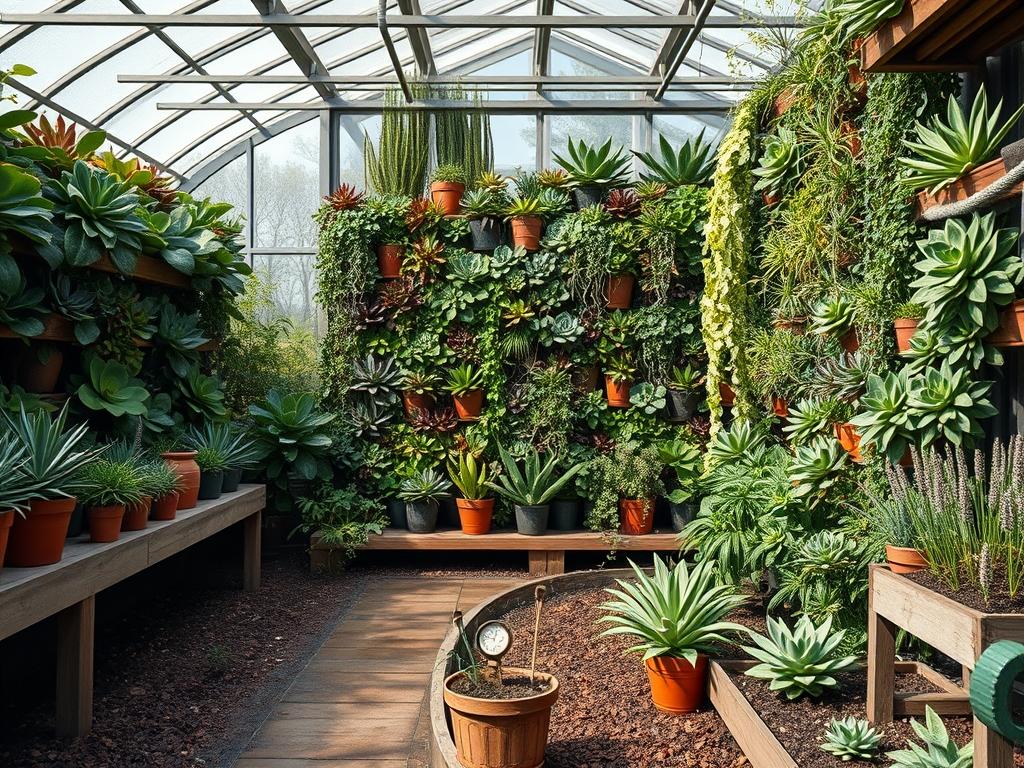
Modern landscaping often faces the challenge of maximizing green space within restricted footprints, such as narrow urban side yards or compact patios. Vertical succulent walls provide a sophisticated solution to this spatial constraint, allowing property owners to introduce high impact botanical textures without sacrificing floor area. These living structures serve as more than just decorative accents; they function as architectural focal points that can mask unsightly retaining walls, improve air quality through biofiltration, and significantly enhance curb appeal. In arid or Mediterranean climates, where traditional turf requires excessive irrigation, vertical succulent gardens exemplify sustainable xeriscaping by utilizing drought tolerant species that thrive in elevated environments. Integrating these systems requires a deep understanding of vertical drainage, solar orientation, and the structural integrity of the mounting surface to ensure the installation remains a permanent asset rather than a fleeting seasonal novelty.
Landscape Design Principles
Successful vertical landscape design hinges on the same fundamental principles applied to traditional garden beds, yet it operates on a vertical plane that demands stricter attention to gravity and visual weight. Symmetry and balance are crucial when designing a living wall. A formal garden might utilize a mirrored arrangement of species, whereas a contemporary or xeriscape design often favors asymmetrical groupings that mimic the natural flow of succulents clinging to a cliffside. Establishing a focal point is essential; this can be achieved by using a large Agave or a cluster of vibrant Echeveria at the third-way point of the frame to draw the eye.
Elevation layers are equally important. Just as a garden bed has a foreground, middle ground, and background, a succulent wall utilizes varying depths of plant material to create three dimensional interest. Using trailing species like Senecio rowleyanus (String of Pearls) at the bottom provides a “spilling” effect that softens the rigid edges of the frame. Meanwhile, rosettes with significant height, such as Aeonium, can be placed strategically to break the flat surface of the wall.
Irrigation planning must be integrated into the design phase rather than added as an afterthought. Because vertical installations lose moisture differently than ground level beds, the design should account for the natural migration of water from the top modules to the bottom. Walkways and surrounding hardscaping should also be considered; the placement of the wall should allow for easy access for maintenance while ensuring that the drainage exit does not create slip hazards on stone or concrete paths. Creating a visual balance between the living wall and the surrounding landscape often involves repeating specific colors or textures from the wall in the horizontal beds below, perhaps by using the same Crushed Granite or Pea Gravel as a mulch layer at the base of the structure.
Plant and Material Selection
Selecting the right biological components is the most critical factor in the longevity of a vertical succulent wall. The environment of a vertical planter is inherently more stressful than the ground; the soil volume is smaller, and the exposure to wind and sun is often more intense.
| Plant Type | Sun Exposure | Soil Needs | Water Demand | Growth Speed | Maintenance |
| :— | :— | :— | :— | :— | :— |
| Echeveria | Full / Part Sun | Pumice-rich | Low | Slow | Low |
| Sedum | Full Sun | Sandy Loam | Low | Fast | Medium |
| Sempervivum | Full Sun | Gritty Mix | Very Low | Slow | Minimal |
| Crassula | Part Shade | Porous Mix | Moderate | Moderate | Medium |
| Senecio | Part Sun | Cactus Mix | Low | Moderate | Low |
| Graptopetalum | Full / Part Sun | Well-draining | Low | Fast | Low |
The hardware used for the wall must be equally durable. Professional installs often utilize Modular Polypropylene Trays or Stainless Steel Mesh frames. For the substrate, a standard potting soil is unacceptable because it compacts and restricts oxygen to the roots over time. Instead, a specialized blend of Perlite, Coconut Coir, and Pumice is preferred to maintain a lightweight profile while ensuring maximum aeration and drainage.
Implementation Strategy
The implementation of a vertical succulent wall begins with structural assessment. You must ensure the wall, whether it is a timber fence or a masonry retaining wall, can support the combined weight of the frame, saturated soil, and mature plants. For large scale projects, mounting a Waterproof Membrane or Polyethylene Sheet behind the frame is mandatory to protect the building envelope from moisture damage.
Grading the area beneath the installation is the next step. Even though the plants are vertical, water will exit the bottom of the structure. A slight grade away from the foundation is necessary, often leading to a hidden French Drain or a bed of Drainage Rock. If the wall is part of a larger backyard remodel, the edging of this drainage area should match the home’s existing hardscaping, such as Steel Edging or Flagstone.
Once the frame is mounted using Galvanized Lag Bolts or Masonry Anchors, the planting process begins. It is often easier to plant modular trays horizontally and allow them to root for four to six weeks before hanging them vertically. This prevents the plants from falling out during the initial transition. During this phase, apply a Slow-release Fertilizer to provide a steady nutrient supply. When placing the plants, ensure the root balls are snug within the Geotextile Fabric or mesh. To finish the look and help with moisture retention, a thin layer of Preserved Moss or Fine Bark Mulch can be tucked between the succulents to hide the underlying structural elements.
Common Landscaping Failures
The most frequent failure in vertical succulent gardening is inefficient irrigation. Gravity causes water to pool at the bottom of the wall while the top rows remain desiccated. To solve this, a multi-zoned Drip Irrigation System should be used, where the top rows receive more frequent, shorter durations of water than the bottom. Another common error is root overcrowding. Designers often pack plants too tightly for immediate “fullness,” but this leads to competition for nutrients and stunted growth within a single season. Proper spacing, usually leaving about two inches between rosettes, allows for healthy expansion.
Soil compaction is a silent killer in vertical systems. If the medium is too heavy, it will slump to the bottom of the cells, crushing the delicate roots of the succulents. This is why a mineral-heavy substrate is non-negotiable. Furthermore, many homeowners ignore the impact of wind. High-rise balconies or exposed walls can experience “wind burn” which dehydrates succulents faster than the sun does. In these cases, selecting species with thicker waxy cuticles, like Graptopetalum, is a strategic necessity. Finally, neglecting the drainage exit can lead to algae growth on the wall or staining of the hardscape below. A controlled drainage channel is the only way to maintain a professional appearance.
Seasonal Maintenance
Landscape management for a succulent wall changes with the calendar. In the Spring, the focus is on rejuvenation. This is the time to prune leggy stems using Bypass Pruners and to replace any specimens that did not survive the winter. Applying a diluted, low-nitrogen fertilizer during the first warm weeks will kickstart the growing season.
During the Summer, the primary task is monitoring hydration. On days exceeding ninety degrees, even succulents may require a light misting or an extra irrigation cycle to prevent shriveling. In Autumn, as growth slows, reduce water frequency significantly. This is also the time to check the integrity of the mounting hardware and ensure no debris has clogged the drainage holes.
Winter demands the most caution, especially in regions prone to frost. While many Sempervivum species are cold hardy, others will need protection. Moving modular panels into a garage or covering the entire wall with Frost Cloth during overnight freezes can prevent cellular collapse in the plants. If the wall is a permanent outdoor fixture in a cold climate, ensuring the soil is dry before a freeze is the best way to prevent root damage, as wet roots are far more susceptible to ice crystals.
Professional Landscaping FAQ
What is the best way to water a vertical wall?
Use a built-in drip irrigation system with emitters at the top of every second row. This ensures even moisture distribution as gravity pulls water down through the medium, preventing the bottom plants from being overwatered or the top ones from drying.
Can I build a succulent wall in the shade?
Yes, but you must select shade-tolerant species like Haworthia or certain Crassula varieties. Most vibrant succulents lose their color and become “leggy” without at least six hours of bright, indirect light or filtered sun per day.
How do I prevent the soil from falling out?
Use a high-quality Geotextile Liner or a fine-gauge Stainless Steel Mesh to hold the substrate in place. Allowing the plants to root for several weeks in a horizontal position before hanging them creates a natural root mat that secures the soil.
Do vertical walls require specific fertilizers?
Succulents have low nutrient requirements. Use a balanced, water soluble fertilizer diluted to half strength during the spring and summer. Avoid high nitrogen formulas, as these can cause weak, rapid growth that compromises the plant’s ability to stay anchored vertically.
How long do vertical succulent walls typically last?
With professional installation and regular maintenance, a vertical wall can thrive for five to ten years. Individual plants may need replacing every few seasons as they outgrow their space, but the structural components are designed for long-term outdoor use.