
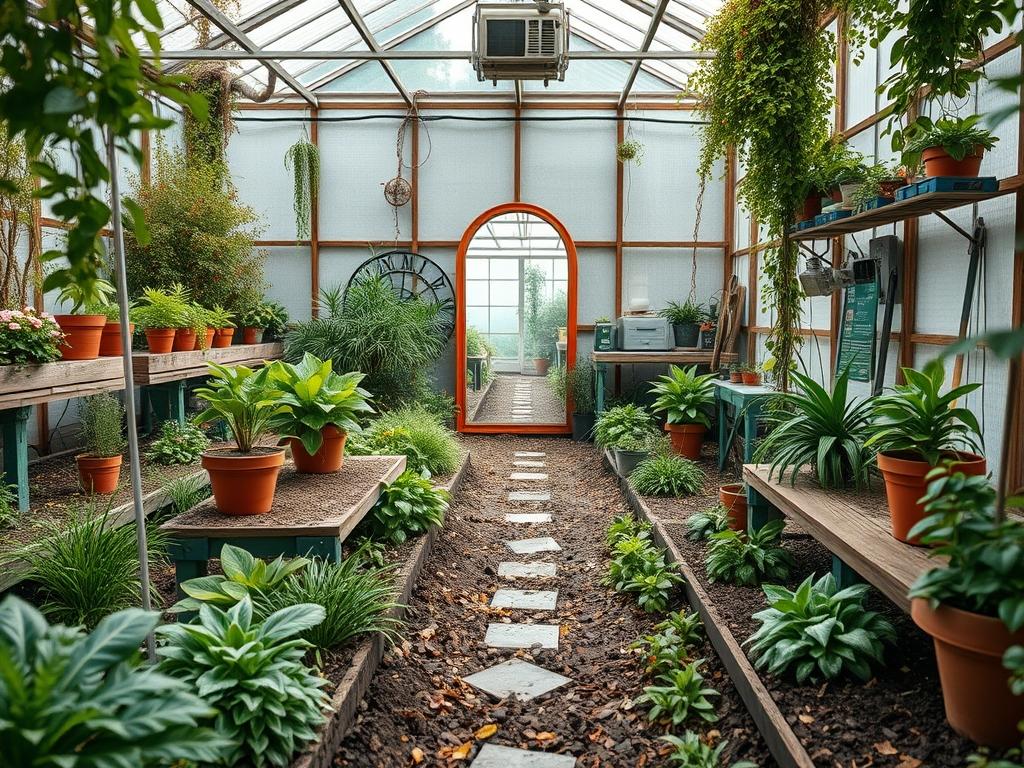
Small footprint gardens often suffer from claustrophobic boundaries and limited light penetration. In dense urban environments, high walls and narrow alleyways restrict the perceived volume of the outdoor space, frequently leaving the homeowner with a cramped and shadowed patio. Landscape architects frequently employ mirrors to mitigate these spatial limitations, utilizing reflective surfaces to dissolve hard boundaries and introduce a sense of infinite continuation. While the aesthetic goal centers on depth, the functional aim involves improving light quality for understory plantings and enhancing the overall curb appeal of the property. Selecting the right mirror and positioning it requires a calculated approach to site analysis, considering solar orientation, wind exposure, and the existing topography to ensure the illusion remains convincing throughout the day.
The strategic placement of reflective surfaces does more than just trick the eye; it fundamentally alters the microclimate of a garden. By reflecting sunlight into shaded northwest corners, you can expand your plant palette to include species that would otherwise struggle in low light. This technique requires an understanding of the sun’s path to avoid creating concentrated “hot spots” that might scorch delicate foliage or cause glare issues for neighbors. A professional installation considers the integration of mirrors not as an afterthought, but as a primary structural element that works in tandem with retaining walls, raised beds, and irrigation systems. When executed correctly, a mirror acts as a secondary window, pulling the greenery of the garden into the reflection and blurring the line between the built environment and the natural landscape.
Landscape Design Principles
Successful garden design relies on a hierarchy of visual interest, and mirrors are king when establishing focal points. When a mirror is placed at the terminus of a walkway, it creates a “long view” that suggests the path continues into a hidden grove or another room of the garden. This relies heavily on symmetry. If the garden features a formal layout, the mirror should be framed with materials that match the existing hardscaping, such as reclaimed brick or wrought iron. For more organic, contemporary designs, frameless mirrors can be recessed into stone walls to create a seamless, portal-like effect.
Elevation layers are equally critical. A mirror placed at ground level can reflect the texture of pea gravel or flagstone, while a mirror mounted at eye level focuses on the mid-story canopy. To ensure the reflection feels natural, landscape architects often use the principle of “leaking over” the edges. This involves planting vines or climbing roses around the perimeter of the mirror so that the edges are softened by foliage. This breaks up the hard rectangular lines and makes the mirror appear as an opening in a hedge. Furthermore, the angle of the mirror must be slightly adjusted to avoid reflecting the photographer or the back of the house; a subtle 5-degree tilt toward the ground or a specific planting cluster often yields the most immersive results.
Irrigation planning must account for these reflective surfaces. Over-spray from oscillating sprinklers can leave mineral deposits and water spots on the glass, which quickly ruins the illusion of depth. Therefore, drip irrigation lines should be prioritized near mirrored installations. These lines deliver water directly to the root zones of the surrounding plants without compromising the clarity of the reflective surface. Visual balance is maintained by ensuring that the reflected image is as deliberate as the physical garden itself, avoiding reflections of trash bins, air conditioning units, or weathered utility meters.
Plant and Material Selection
The materials used in a mirrored garden must withstand high humidity and temperature fluctuations. For the mirrors themselves, acrylic mirrors are often preferred over glass for safety and weight considerations, though toughened glass offers superior clarity and scratch resistance. Frames should be constructed from marine-grade stainless steel or pressure-treated cedar to prevent rot and corrosion.
| Plant Type | Sun Exposure | Soil Needs | Water Demand | Growth Speed | Maintenance Level |
| :— | :— | :— | :— | :— | :— |
| Japanese Maple | Partial Shade | Well-Drained, Acidic | Moderate | Slow | Medium |
| Hosta | Full Shade | Rich, Organic | High | Medium | Low |
| Creeping Jenny | Full Sun to Shade | Moist, Loamy | High | Fast | Low |
| Boxwood | Full Sun to Partial Shade | Well-Drained | Moderate | Slow | High (Pruning) |
| Maidenhair Fern | Full Shade | Humus-Rich, Moist | High | Medium | Medium |
| Star Jasmine | Full Sun to Partial Shade | Well-Drained | Moderate | Fast | Medium |
Implementation Strategy
The installation begins with a thorough site survey to assess the grading and drainage of the area. Mirrors should never be placed in low-lying spots where water pulls or collects, as this leads to moisture seepage behind the silvering, causing the mirror to cloud or “bloom” over time. If the mirror is to be mounted on a retaining wall, ensure that the wall is structurally sound and that a vapor barrier is installed between the masonry and the mirror backing.
First, identify the primary viewing angle, usually from a patio seating area or through a back door. Use a temporary plywood template to test locations and angles throughout the day to monitor sunlight reflections. Once the position is finalized, prepare the mounting surface. For wall-mounted units, use Z-clips or heavy-duty galvanized brackets that allow for a small air gap behind the mirror. This ventilation is crucial to prevent the buildup of condensation which can damage both the wall and the reflective coating.
If the mirror is being integrated into a hedge, construct a sturdy wooden frame using 4×4 pressure-treated posts set in concrete. The mirror should be secured with outdoor-rated silicone sealant that remains flexible during thermal expansion. For the ground preparation, apply a 2-inch layer of organic mulch or decorative river rock at the base of the mirror. This prevents soil from splashing onto the glass during heavy rain and provides a clean transition from reflection to ground. Finally, integrate low-voltage LED uplighting to illuminate the reflection at night, providing a dramatic depth effect even after sunset.
Common Landscaping Failures
The most frequent mistake in mirrored garden design is the failure to account for drainage. If a mirror is installed flush against a wall without proper weep holes or an air gap, moisture becomes trapped. This leads to the deterioration of the backing and can encourage the growth of mold or mildew on the surrounding structure. Similarly, improper grading at the base of the mirror can cause water to “back up” against the frame, leading to premature rot in wooden components.
Another common failure involves root overcrowding and improper spacing. Homeowners often plant too closely to the mirror in an attempt to hide the edges immediately. However, as the root balls of species like Boxwood or Privet expand, they can exert pressure on the mirror’s foundation or frame, causing it to tilt or crack. Always research the mature spread of your chosen plants and leave at least 12 to 18 inches of clearance between the main root mass and the mirror’s vertical plane.
Irrigation inefficiencies also plague these designs. Using high-pressure spray heads near glass surfaces results in “alkali burn” from hard water minerals, which is nearly impossible to remove without professional polishing. Furthermore, many fail to consider bird safety. Large, clear reflections of the sky can lead to bird strikes. To prevent this, architects often use etched patterns, trellis overlays, or ultraviolet decals that are visible to birds but remain subtle to the human eye.
Seasonal Maintenance
Maintenance requirements fluctuate with the seasons, requiring a proactive approach to preserve the mirror’s integrity. In the spring, inspect all mounting hardware for signs of shifting or rust after the winter thaw. This is the optimal time to clean the surface with a solution of distilled water and white vinegar to remove any accumulated grime without leaving streaks. Check the drip irrigation emitters to ensure they are not clogged and are delivering water precisely to the base of the surrounding foliage.
During the summer, the primary focus shifts to managing the reflected heat. Monitor your plants for signs of leaf scorch or wilting, especially those directly opposite the mirror. You may need to increase the mulch depth to 3 inches to retain soil moisture. In autumn, the priority is debris removal. Falling leaves and twigs can become trapped in the gap behind the mirror or pile up against the frame, creating a fire hazard or a rot point. Clear these out weekly.
Winter maintenance is critical in regions subject to freezing temperatures. If you are using an acrylic mirror, be aware that it will contract and expand more significantly than glass. Ensure that the mounting clips provide enough “play” to prevent warping. If the mirror is in a particularly exposed location, consider covering it with a breathable outdoor fabric during extreme ice storms to prevent physical damage from falling branches or heavy snow loads. Always avoid using metal scrapers to remove ice from the surface, as this will permanently scratch the finish.
Professional Landscaping FAQ
How do I prevent birds from flying into the mirrors?
Birds often mistake reflections for open space. To prevent strikes, use parabolic mirrors that distort the reflection slightly, or install a decorative wooden trellis over the glass. You can also apply UV-reflective decals which are invisible to humans but highly visible to birds.
What is the best way to clean outdoor mirrors without streaking?
Avoid using standard glass cleaners which can contain harsh chemicals. Instead, use a mixture of one part white vinegar to four parts distilled water. Apply with a microfiber cloth and buff in a circular motion to remove hard water spots.
Can mirrors cause fires in the garden?
While rare, flat mirrors can reflect sunlight with enough intensity to scorch plants. To mitigate risk, ensure the mirror is not positioned to catch the direct midday summer sun at a focalizing angle. Using tinted or antique mirrors also reduces the intensity of reflected rays.
What thickness of glass should I use for an outdoor installation?
For residential garden applications, use 6mm toughened safety glass. This thickness provides the necessary durability to withstand wind pressure and minor impacts from garden debris, while the tempering ensures that if the glass does break, it shatters into dull granules.
How do I stop the mirror from fogging up in the morning?
Fogging is caused by temperature differentials. Ensure there is a 10mm air gap behind the mirror to allow for ventilation. You can also apply a commercial anti-fog coating used for automotive windshields, though this will require reapplication every few months.